AI can't polish your turd. Adopt a systems mindset.
- Service design
- AI
- Systems
Why AI implementation demands a logical, systems-minded view of your service, and how to find the real problems before throwing a bot at them.

When businesses dive into AI, the spotlight often falls on the most visible applications, particularly chatbots (remember when everyone thought they needed an app?). These conversational interfaces have their place, but fixating solely on their interaction often misses the point entirely. To truly harness AI's power, (as a service designer, you'll know this well) we need to apply a systems mindset. We need to look beneath the shiny surface to the underlying logical problems within our systems.
At its core, logic is the invisible thread that lets us get to grips with, pick apart, and make better any kind of system, whether you can touch it or not. It's our toolkit for figuring out what causes what, seeing what might happen next, and pinpointing why things go wrong. It's used every day to design solutions with policy, technology and people. The basic idea helps us draw some surprisingly clear parallels across fields.
For this article I'll use two familiar (to me) examples. One tangible and the other relatively intangible.
- Plumbing, which offers tangible examples of systemic issues.
- Service design, which deals with (largely) intangible flows.
This is more about systems thinking and how AI can assist you than anything else, but I find analogies help with framing to the unfamiliar.
A brief note on systems thinking
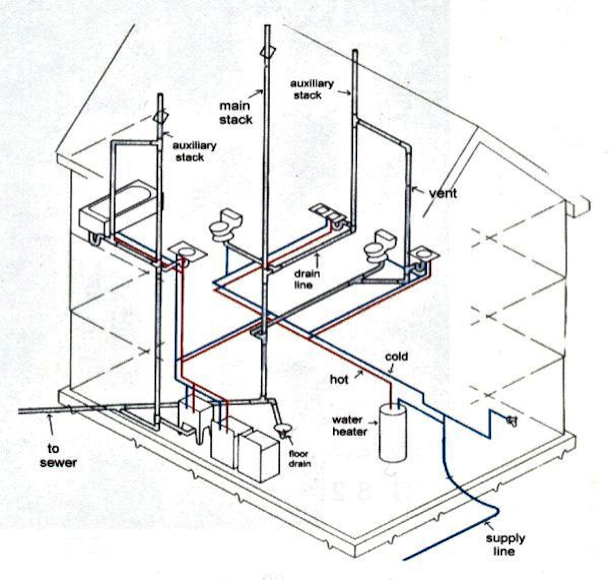
Just like a plumber carefully plans pipework, manages water flow, spots blockages, and patches up leaks to ensure a functional system, a service designer applies similar logical thinking to intangible services. In both disciplines, we're really talking about flows: in plumbing, it's the flow of water and electricity (hopefully the two never meet); in service design, it's the flow of information, value, customer experiences, etc. Both are trying to optimise these flows, minimise friction, prevent waste, and ensure the system delivers its intended purpose efficiently and effectively (to an outcome). Think about a system in motion.
But what does this have to do with AI? Fact is, this isn't to do with AI. But AI can help you find and solve some issues through systems thinking. In both cases you need to diagnose the problem before selecting a solution. Systems thinking helps us do this. It is a precursor; a discovery activity that enables you to pinpoint areas for intervention. It will let you know if you even need an AI as a feature, or if a simple policy change or mass fire and rehire will achieve the same outcome with fewer side effects. Point is, you have options (some of them shitty ones).
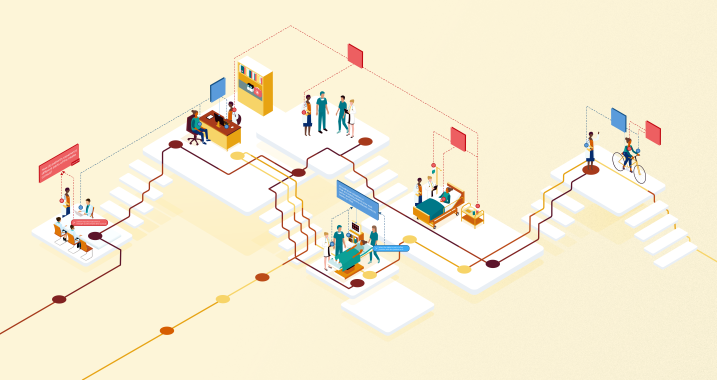
Uncovering systemic flaws with AI assistance, before throwing a bot at surface level issues
If we're only looking at the user interface, we risk using AI to paper over cracks rather than fixing the foundations. A chatbot, for example, might efficiently answer FAQs, but if those FAQs exist because of deeper systemic information leaks or poorly defined boundaries, the core problem persists. AI's true value lies in its ability to analyse vast amounts of data, identify patterns, and automate processes that address these fundamental logical problems. This makes it a decent assistant to have around if you're investigating a large organisation's flow during service discovery.
Next, (probably the useful bit) I wanted to point out some logical anti-patterns that you may find in your organisation that AI can help solve. I've thrown in some more plumbing analogies because that helped me, it may also help you.
1. Silos (or Siloed Operations)
Imagine different parts of a company acting like separate islands, barely talking to each other.
- The Plumbing Analogy: It's like having separate plumbing systems for your kitchen and bathroom, and having to turn on and off the main water supply for each room every time you want to use them.
- The AI Solution: AI can act as a central nervous system, connecting disparate data sources across departments. It can analyse customer journeys across these 'silos' to identify friction points caused by fragmented information or processes. For example, AI can unify customer profiles, ensuring consistent service regardless of the department a customer interacts with, or automate handovers between teams that typically operate in isolation.
2. Redundancy/Duplication
This is when you're doing the same thing twice, or even more, without needing to.
- The Plumbing Analogy: It's like having two separate water meters measuring the same water entering your house; one is simply unnecessary.
- The AI Solution: AI is exceptionally good at spotting and eliminating redundant tasks or data. It can identify duplicate data entries across systems, flag repetitive manual processes that could be automated, or consolidate overlapping customer contact points, reducing customer effort and internal waste.
3. Single Points of Failure
A single point of failure is a part of a system that, if it fails, will cause the entire system to stop working.
- The Farm Kid Analogy (I was one of those as well): This is like having a big vent on the outside of your death star that some farm kid can eyeball a proton torpedo into and take your whole business offline.
- The AI Solution: AI can distribute knowledge and automate critical decision points currently reliant on a single individual. By codifying expertise and automating approvals or escalations, AI reduces dependency on human bottlenecks. It can also predict potential system failures, allowing for proactive maintenance rather than reactive crisis management. If Grand Moff Tarkin had an independent AI check over the death star plans, he could have spotted Galen Erso's intentional SPoF. Which is quite crazy considering the number of AI in that galaxy.
4. Lack of Feedback Loops
Without good feedback, a system can't learn or get better.
- The Plumbing Analogy: It's like a heating system where the thermostat is broken; it just keeps pumping out heat without knowing if the room is too hot or too cold. Eventually this becomes unsustainable and breaks, much like businesses who do not listen to the voice of their customers, staff, shareholders, partners etc.
- The AI Solution: AI can establish sophisticated feedback loops by analysing sentiment from customer interactions, identifying recurring pain points from support tickets, or tracking the effectiveness of service changes in real time. This data can then be automatically fed back to design teams or operational leaders, enabling continuous improvement.
5. Misalignment of Incentives
This happens when what people are rewarded for doing doesn't match the overall goals of the service.
- The Plumbing Analogy: It's like rewarding a plumber for how many pipes they install, rather than whether the entire system actually works without leaks. Shout out to the new builds.
- The AI Solution: AI can provide holistic performance insights that highlight the true impact of departmental actions on the end-to-end customer journey. By showing how individual metrics contribute (or detract) from overall service outcomes, AI can help re-engineer incentive structures to promote customer-centricity rather than narrow, siloed targets. For example, a customer service department might be incentivised solely on call handling time. AI can analyse not just call duration, but also the customer's sentiment and subsequent journey, revealing that fast calls often lead to higher rates of repeat calls, online complaints, or product returns handled by other departments. AI's holistic view then shows that incentivising first-call resolution and customer satisfaction, even if calls are slightly longer, significantly reduces overall service costs and improves the end-to-end customer experience.
6. Complexity (Excessive)
When something is just too complicated, it causes problems for everyone.
- The Plumbing Analogy: It's like a plumbing system with dozens of unnecessary valves, pipes going in circles, and no clear way to shut off the water to a single tap.
- The AI Solution: AI can simplify complex processes by automating decision trees, guiding users through convoluted tasks, or intelligently routing requests to the correct destination without requiring manual navigation. It can also analyse process maps to identify areas of unnecessary complexity ripe for streamlining. For example, consider a complex insurance claim process that involves numerous forms, conditional questions, and manual document uploads. AI can simplify this by providing an intelligent, guided pathway. Instead of asking all possible questions upfront, the AI dynamically presents only the relevant next steps based on previous answers, automates the categorisation and routing of uploaded documents, and pre-fills known information, vastly reducing the user's cognitive load and the potential for errors.
7. Path Dependency (or Lock-in)
This is when past decisions limit what you can do in the future, even if those past choices aren't the best anymore.
- The Plumbing Analogy: It's like a house built with old lead pipes; replacing them is costly and disruptive, so you might stick with them even if they're not ideal.
- The AI Solution: While AI can't magically remove legacy infrastructure, it can act as a layer of abstraction or intelligent automation on top of it. This allows businesses to improve service delivery and customer experience without a full, disruptive overhaul of outdated systems. AI can also help model the true costs and benefits of modernising, making the case for breaking free from past constraints.
8. Poorly Defined Boundaries/Scope Creep
When it's unclear who's responsible for what, or when projects grow out of control.
- The Plumbing Analogy: It's like a shared drainage system where no one is sure whose responsibility it is to clear a blockage once it leaves a specific property.
- The AI Solution: AI can provide clarity by intelligently classifying and routing customer queries or tasks based on their content and context, ensuring they land with the correct team. It can also monitor task handovers, identifying where responsibilities become ambiguous and work gets lost, highlighting areas where boundaries need clearer definition.
9. Fragility (Lack of Resilience)
A fragile system breaks easily under pressure, rather than bouncing back.
- The Plumbing Analogy: It's like a narrow water pipe that bursts when too many taps are turned on at once, rather than having the capacity to handle increased flow.
- The AI Solution: AI can build more resilient services by predicting surges in demand, dynamically allocating resources (e.g., routing customers to available agents or scaling cloud infrastructure), and automating disaster recovery protocols. It can also identify single points of failure before they become critical.
10. Lack of Standardisation
When there's no consistent way of doing things.
- The Plumbing Analogy: It's like a house where every tap has a different fitting and requires a unique spanner; nothing is consistent, making repairs a nightmare.
- The AI Solution: AI can enforce standardisation by guiding employees through consistent processes, automating data entry to ensure uniformity, or creating intelligent templates for customer communications. It can also identify deviations from standard procedures, allowing businesses to address inconsistencies.
11. Data Inconsistency/Integrity Issues
When the information a system relies on isn't accurate or up-to-date.
- The Plumbing Analogy: It's like having faulty pressure gauges and thermometers on a boiler; you get incorrect readings, leading to bad decisions about how to run the heating system.
- The AI Solution: AI can perform continuous data validation and cleansing, identifying and correcting inaccuracies across different systems. This ensures that decisions made by both human staff and other AI systems are based on reliable information, leading to better outcomes for customers and the business.
The Shift in Mindset
Ultimately, the most impactful AI implementations won't come from simply trying to make a chatbot sound more human or adding another layer of automation to a broken process. It definitely won't come from engaging your brain less and outsourcing every thought you wish to have. They will come from service designers (I'm biased) and business leaders adopting a systems mindset: rigorously examining the underlying logical architecture of their services, identifying the leaks, bottlenecks, and other systemic flaws, and then strategically deploying AI to address those root causes. This approach doesn't just improve interactions, it rebuilds the entire service on a stronger, more efficient foundation.